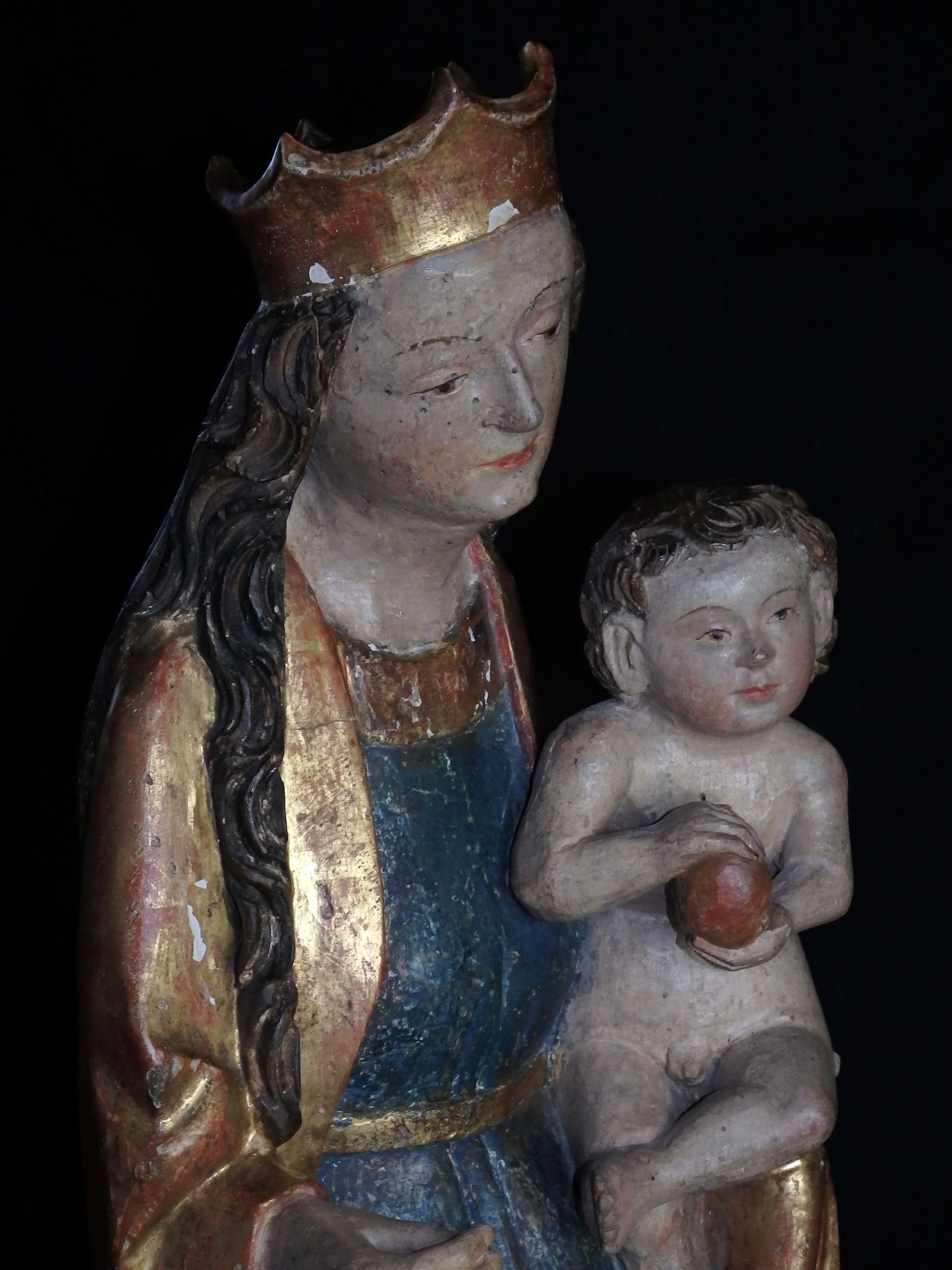
Madonna on the Crescent Moon with the Christ Child, c. 1480
OBJECT
Late Gothic Madonna on the crescent moon with the Christ Child
ORIGIN
probably from a western Saxon–eastern Thuringian workshop or its sphere of influence
probably Altenburg/Zwickau area, created between 1475 and 1495.
MATERIAL
Probably lime or alder wood, carved in the round, polychrome painted and partially gilded.
DESCRIPTION
Masterly late Gothic figure of the Virgin standing on a crescent moon with upward-pointing horns (Apocalypse, Revelation 12:1: “a woman clothed with the sun, and the moon under her feet”). The Madonna on the crescent moon is a classic late Gothic motif that gained popularity particularly from the middle of the 15th century.
The naked Christ Child sits on Mary’s left arm and holds an apple in both hands. The apple serves as a theological attribute. It marks Christ as the “new Adam” who overcomes original sin (the Fall through the fruit in Paradise) and redeems mankind. Mary wears a simple three-pointed crown identifying her as Queen of Heaven (Regina Coeli). Her right hand is slightly open towards the front. It originally held a separate, inserted attribute, very probably a gilded sceptre. The mantle is draped around the body in deep, bowl-shaped folds. At the side the fabric gathers in angular cascades (so-called crumpled or tubular folds). This breaking of the folds is a key feature of the late Gothic from around 1470, but here it still shows a rather calm, vertically oriented basic line reminiscent of the Soft Style of the mid-15th century.
Mary’s face is oval, with a high, noble forehead, finely cut almond-shaped eyes and a narrow, contemplative mouth. The body of the Christ Child is compact. He has an unusually roundly modelled head with full cheeks, which already reveals a stronger observation of nature.
The sculpture combines the calm elegance of the so-called Soft Style with the increasingly angular fold forms of the late Gothic period. In particular, the carefully carved hair, the balanced proportions and the high-quality treatment of the drapery point to an accomplished workshop in central Germany.
DIMENSIONS
Height: 86 cm
Width: 24 cm
Depth: 18 cm
Weight: 5.5 kg
CONDITION
Good condition with signs of age. The polychromy largely overpainted. Historical restorations and reworking of the polychromy. The crown and the right hand possibly historical additions. Elaborate historical stabilisation of the base and cracks by means of dovetail wedges and edge reinforcement. The polychromy partially rubbed. The gilding with flaking. At the front a fine, barely visible stress crack. Historical woodworm damage, inactive.
REFERENCES
Stylistically, this Madonna on the crescent moon can be assigned to the Altenburg/Zwickau school, which is supported by structural parallels to the Madonna on the crescent moon in the Kunstsammlungen Zwickau (inv. no. L/V/65/13/K3). There are also stylistic parallels to the Saint Catherine from the church of Mülsen St. Jacob, made by the Zwickau woodcarver Peter Breuer (1472-1541) (Kunstsammlungen Zwickau Max-Pechstein-Museum (inv. no. L/V/65/2/K3).
The present Madonna is probably the work of a western Saxon–eastern Thuringian master (Altenburg/Zwickau) who was active immediately before Peter Breuer’s breakthrough (c. 1490–1500) or worked as a contemporary but more tradition-conscious competitor in the area around Zwickau. The sculpture shows clear stylistic correspondences and an aesthetic of piety like Breuer’s early altar figures, but retains a stricter, older formal vocabulary in the hair.
PROVENANCE
From a long-standing southern German private collection.
ACQUIRING CULTURAL PROPERTY SAFELY
We hereby confirm the impeccable provenance of the present sculpture. At the time of sale it is free of third-party rights.
Price
€13,400